Zandora Pest EliminationZandora Pest Elimination

Stinging Insect and Nest Removal Denver

Stinging insect control in Kent County properties balances public safety with deliberate property preservation. Colonies built by Vespula species or aerial paper wasps present distinct structural hazards depending on…
Get My Free Estimate →
Stinging Insect and Nest Removal in Denver, DE
Quick answer
  • What is included: Species verification, localized aerosol or insecticidal dust barrier treatment, full physical nest detachment, and void cleanup.
  • Turnaround time: On-site physical extraction typically finishes in 45 to 90 minutes depending on ladder heights and void accessibility.
  • Ballpark pricing: Local treatments begin at a $150 minimum diagnostic-and-removal base rate, scaling between $225 and $475 based on ladder height, structural void access, and colony dimensions; exact quotes are confirmed after an on-site structural inspection.
  • Species targeted: Paper wasps, bald-faced hornets, yellowjackets, European hornets, and non-honeybee terrestrial ground nesters.
  • Booking process: Initial telephone intake schedules a local technician arrival window, followed by immediate on-site structural inspection and treatment.

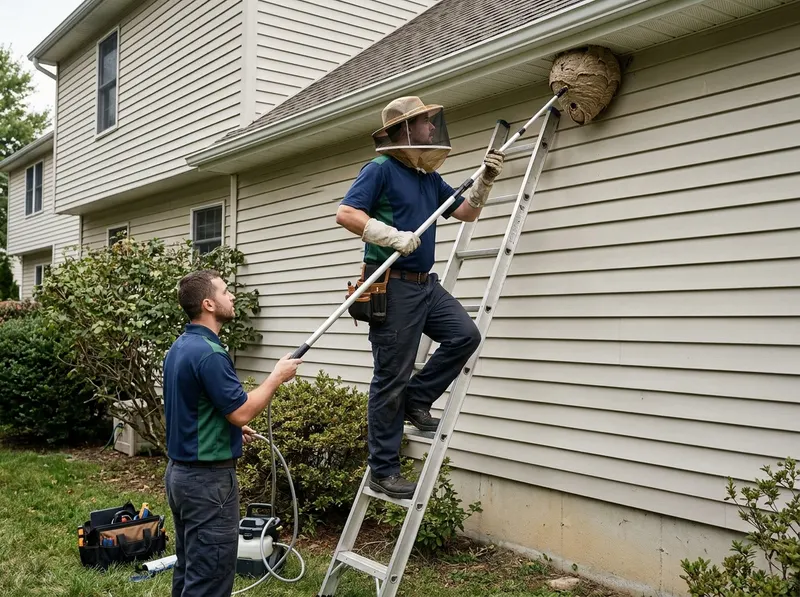
Stinging insect control in Kent County properties balances public safety with deliberate property preservation. Colonies built by Vespula species or aerial paper wasps present distinct structural hazards depending on their chosen architecture. In residential communities such as Willow Run and Briar Park, umbrella-shaped paper wasp nests commonly attach to low soffits, open porch rafters, and window lintels. These aerial nests allow straightforward aerosol knockdown and immediate manual scraping. Conversely, aerial yellowjackets or bald-faced hornets along wooded parcels near Derby Run and Moores Lake District often nest inside exterior wall voids, venting caps, or tall hardwood canopies. Ground-nesting yellowjackets also exploit abandoned rodent burrows across expansive lawns in Meadowbrook Acres and Garrison Lake Green, where mower traffic risks sudden colony agitation.

Selecting professional mechanical extraction over aerosol DIY sprays avoids structural moisture damage and drywall staining. Over-the-counter consumer sprays frequently trap surviving yellowjackets behind sheetrock, causing them to chew inward through interior drywall or baseboards into occupied living quarters. A targeted Integrated Pest Management (IPM) approach introduces micronized pyrethroid or silica dusts directly into entrance holes through directional micro-injectors, reaching brood chambers without soaking building envelopes. Once biological activity stops, technicians mechanically cut or peel the nest substrate, bag the comb to prevent secondary carpet beetle or dermestid infestations, and treat the underlying anchor point to disrupt orientation pheromones.

Work protocols adapt directly to architectural elevations across Denver neighborhoods. Split-level and two-story homes in Quaker Hill and the Rodney Village Area require extension ladders reaching heights from 18 to 28 feet to address apex gable overhangs. When colonies nest inside attic soffits or vinyl corner caps, access points are treated and monitored before mechanical sealants are installed. Single, exposed ground or low-eave treatments do not require long-term maintenance contracts, whereas properties adjoining damp acreage near natural waterways may utilize localized repellent bands around vulnerable exterior trim to deter spring queen establishment.

Stinging Insect and Nest Removal cost in Denver

Exposed Ground Nest Extraction (Lawn or Flowerbed)$150 - $225
Accessible Exterior Eave or Porch Nest (Up to 12 Feet)$175 - $250
Second-Story Overhang or Apex Gable Removal (12 to 28 Feet)$250 - $375
Interior Wall Void or Soffit Concealed Nest Remediation$300 - $475

Every job gets a firm, written price after a free on-site visit.

Common questions

What is the initial cost for stinging insect removal in Denver, DE?
The minimum charge for diagnosing and removing an exposed stinging insect nest in Denver, DE is $150, with complex structural wall access or elevated ladder work ranging up to $475 based on confirmed on-site conditions.
Are honeybees included in Denver stinging insect removal services?
Honeybees are non-aggressive beneficial agricultural pollinators and are not exterminated; unmanaged Apis mellifera swarms in Denver are referred to local Kent County beekeepers for live collection and relocation.
How quickly can high-eave hornet nests in Quaker Hill and Meadowbrook Acres be eliminated?
Direct insecticidal dust or aerosol knockdown neutralizes active defensive hornets within 15 to 30 minutes, allowing technician detachment and removal of the paper envelope during the initial appointment.
Why do yellowjackets enter interior wall voids in Rodney Village Area homes?
Yellowjacket queens exploit uncaulked gaps around utility conduit penetrations, weeping vents, and degraded fascia boards along the exterior envelope, building expanding pulp comb against interior insulation.
Is a recurring monthly contract mandatory for nest removal in Denver, DE?
A recurring monthly service contract is not required in Denver, DE, as seasonal stinging insect colonies terminate naturally each winter, making single-treatment mechanical extraction sufficient for individual active nests.
Helpful resources

Trusted references & local links

USA.gov, government & consumer helpBetter Business BureauFTC Consumer AdviceU.S. Small Business AdministrationReady.govU.S. EPAENERGY STARU.S. Dept. of EnergyConsumer.govU.S. Census BureauGoogle Maps, Denver, DE

Get started today

Tell us about your stinging insect and nest removal job in Denver and we'll send a clear, written quote, usually the same day.

Get your free PEST CONTROL SEVICE quote, Denver

We only use your ZIP to check availability, no spam.