Cockroach gel baiting paired with crack-and-crevice treatment addresses indoor German cockroach populations by exploiting aggregation biology rather than dispersing insects with surface repellents. Spraying…
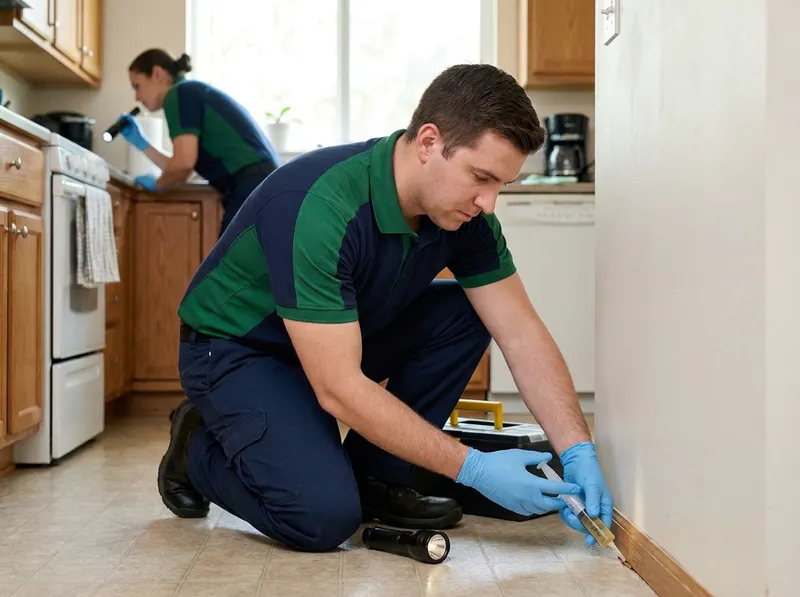
Cockroach gel baiting paired with crack-and-crevice treatment addresses indoor German cockroach populations by exploiting aggregation biology rather than dispersing insects with surface repellents. Spraying broad-spectrum liquid pyrethroids across baseboards often repels foraging adults deeper into wall cavities, extending breeding cycles behind dry utility spaces. Precision baiting applies hydro-absorbent food attractants embedded with slow-acting active ingredients like hydramethylnon or indoxacarb. Nymphs and reproductive females ingest the bait and return to deep harborages, transferring the toxicant to the colony through coprophagy and necrophagy within 24 to 72 hours. This targeted technique deposits micro-beads of gel directly into cabinet drawer tracks, hollow sub-counter frames, appliance motor housings, and utility escutcheons without leaving airborne mists in food-preparation zones.
Older slab homes and split-level residences around Meadowbrook Acres and Willow Run frequently face localized microclimate conditions along foundation pipes and moisture-retaining crawlspace entries. Similarly, slab foundations in Briar Park and Derby Run often experience utility void crossings that shelter roaches near warm dishwasher motors and behind refrigerator compressor lines. Moisture migration around Moores Lake District and Tidbury Creek County Park elevates indoor ambient humidity, shortening the interval between cockroach molting cycles. The gel-and-crack methodology counters this accelerated breeding cycle by inserting an insect growth regulator (IGR) such as pyriproxyfen alongside the toxicant bait. The IGR arrests juvenile development by inhibiting chitin synthesis, preventing immature nymphs from maturing into reproductive adults even if ambient humidity remains elevated.
Single-application gel baiting serves isolated residential kitchens and rental turnovers where infestation levels remain confined to one or two active harborages. If deep wall populations extend across multi-unit party walls or shared plumbing runs, supplemental vacuum extraction and mechanical void dusting using pharmaceutical-grade silica dust provide the necessary follow-up volume. Crack treatment seals access margins with silicone caulk once existing clusters are cleared. The fundamental operational trade-off requires leaving applied bait matrices undisturbed: homeowners must avoid applying aerosol contact sprays or bleach solutions directly over treated hinges and gaps, as chemical contamination spoils the matrix attractant and halts natural ingestion across the population.
Every job gets a firm, written price after a free on-site visit.
Tell us about your cockroach gel bait and crack treatment job in Denver and we'll send a clear, written quote, usually the same day.
 Zandora Pest Elimination