Carpenter ant structural remediation addresses structural excavation caused by Camponotus pennsylvanicus colonies boring smooth galleries through structural wood. Unlike termites, carpenter ants do not ingest…
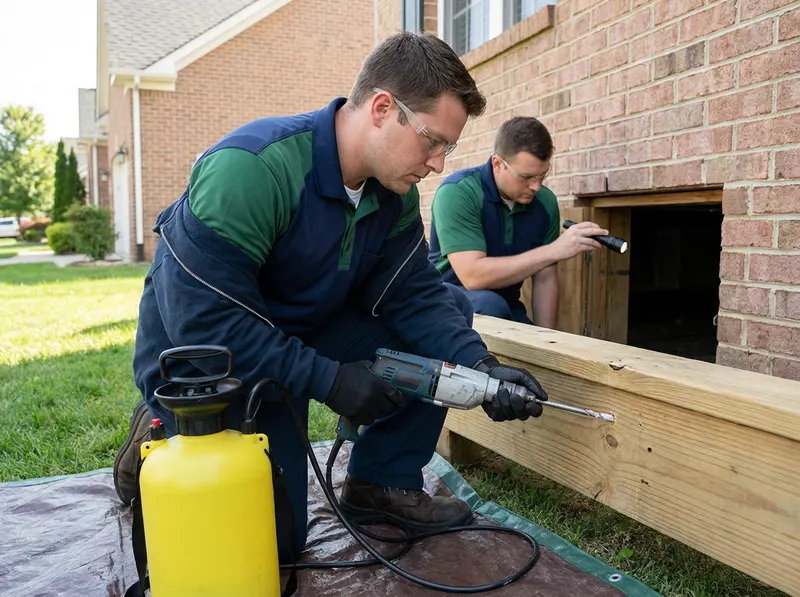
Carpenter ant structural remediation addresses structural excavation caused by Camponotus pennsylvanicus colonies boring smooth galleries through structural wood. Unlike termites, carpenter ants do not ingest cellulose; they hollow out framing, joists, and structural headers to establish secure brood chambers, depositing coarse wood shavings and insect fragments known as frass through exit slits. In Kent County, older housing stock near Moores Lake District, Quaker Hill, and Willow Run often experiences persistent satellite colonies following spring roof leaks or crawlspace moisture accumulation. Remediation involves locating moisture gradients above 18% wood moisture equivalent, identifying foraging trails entering along foundation stems, and treating the parent nest to halt mechanical damage to wall framing.
A single targeted structural remediation protocol is suited for localized infestations where nesting is isolated to an accessible bay, such as a bathroom subfloor or a kitchen window header. When an infestation involves multiple parent nests across damp crawlspaces and exterior shade zones, common in wooded plots across Briar Park and Derby Run, remediation requires deep wall-void aerosol micro-injections paired with non-repellent perimeter suspensions. The functional trade-off between localized void baiting and perimeter barrier remediation lies in initial disruption versus long-term clearance: bait-only systems avoid wall penetrations but take 14 to 30 days to clear a colony, whereas localized pressurized void treatments provide immediate containment of primary satellite galleries with minimal structural drilling.
Properties in Meadowbrook Acres, Garrison Lake Green, and the Rodney Village Area with mature oak cover frequently sustain secondary foraging lines crossing from exterior trees to roof fascia. The remediation standard involves three sequential phases: first, mechanical moisture isolation and sounding of load-bearing timbers; second, targeted void injection using an EPA-registered transfer toxicant that workers carry back to the reproductive queen; third, a contiguous 3-foot vertical and horizontal perimeter foundation spray along exposed concrete. Treatments utilize low-odor, targeted formulations engineered to dry within two hours, eliminating broad indoor chemical exposure and avoiding high-pressure aerosol fogging across living spaces.
Every job gets a firm, written price after a free on-site visit.
Tell us about your carpenter ant structural remediation job in Denver and we'll send a clear, written quote, usually the same day.
 Zandora Pest Elimination